What We Handle
Truck Accidents
When a commercial vehicle causes the crash.
What truck accidents actually means
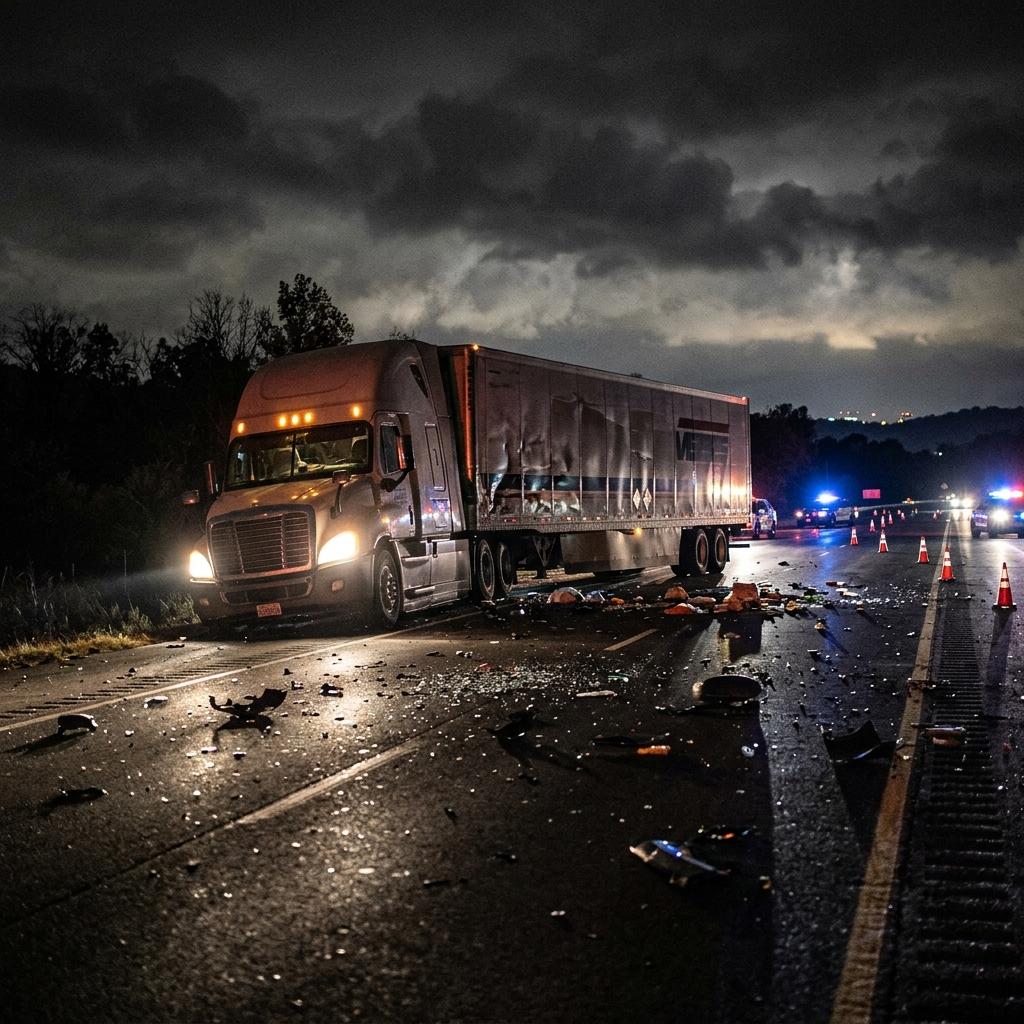
Truck accident cases involve collisions with commercial vehicles — 18-wheelers, tractor-trailers, delivery trucks, and other vehicles regulated by federal and state transportation law. These cases are fundamentally different from car accidents because of the additional layer of federal FMCSA regulations (49 CFR Parts 390–399).
Multiple parties may be liable: the driver, the trucking company, the maintenance provider, cargo loaders, and even the truck or parts manufacturer. Evidence degrades quickly — electronic logging data, black box records, and drug test results must be preserved immediately.
What it takes to have a case
1. Duty
Truck drivers and carriers owe heightened duties under federal FMCSA regulations — hours-of-service limits, vehicle inspection requirements, CDL qualifications, and drug/alcohol testing compliance.
2. Breach
Violations of FMCSA regulations — driving beyond hours-of-service limits, skipping mandatory inspections, falsifying logs, or operating under the influence — may constitute negligence per se in Missouri courts.
3. Causation
The regulatory violation or negligent act must have directly caused the collision. Driver fatigue from exceeding hours-of-service limits that led to the crash is a common causation path.
4. Damages
Truck accident injuries are often catastrophic due to the size and weight differential. Damages typically include extensive medical care, long-term rehabilitation, and significant lost earning capacity.
What we handle within truck accidents
Every situation is different. Here are the most common types we see.
18-Wheeler Collisions
The most common commercial truck accident involving tractor-trailers.
Jackknife Accidents
When the trailer swings out from the cab, often caused by braking issues or driver error.
Underride Crashes
When a smaller vehicle slides beneath the trailer — often fatal.
Cargo Spill / Shift
Improperly loaded or secured cargo causing loss of control or road hazards.
Driver Fatigue
Hours-of-service violations leading to drowsy or impaired driving.
Defective Maintenance
Brake failures, tire blowouts, or mechanical defects from inadequate fleet maintenance.
Missouri vs. Kansas: the rules that matter
Kansas City straddles the state line. Which state's law applies depends on where the incident occurred.
Missouri
- •Statute of limitations: 5 years — RSMo § 516.120
- •Pure comparative fault — RSMo § 537.765
- •FMCSA violations treated as negligence per se
- •Employer vicarious liability for driver negligence within scope of employment
Kansas
- •Statute of limitations: 2 years — KSA § 60-513
- •Modified comparative fault — 50% bar — KSA § 60-258a
- •Federal FMCSA regulations apply equally
- •Multiple defendant liability under Kansas joint and several liability rules
Not sure which state's rules apply? Tell us where it happened →
What an investigation looks like
Initial conversation — Free. We assess the facts and identify all potentially liable parties.
Evidence preservation — Immediate demand letters to preserve ELD data, black box/ECM data, GPS records, maintenance logs, and driver qualification files.
FMCSA compliance audit — Review of the carrier's safety record, hours-of-service logs, drug/alcohol test results, and inspection history.
Expert reconstruction — Accident reconstruction engineers, trucking industry experts, and medical specialists.
Demand or filing — Pre-suit demand against all liable parties; petition filed if necessary.
Resolution — Settlement, mediation, or trial. Multi-defendant cases require coordination across all parties.
What it costs
Yonke Law works on a contingency basis. There is no fee unless we recover compensation for you. The percentage is agreed in writing before any work begins. Your initial consultation is always free. No hourly rates. No retainers. No surprise bills.
What a truck accidents case is actually worth
There's no honest one-line answer. Value depends on the facts of your situation.
Economic Damages
- •Medical expenses (often extensive)
- •Lost wages and future earning capacity
- •Property damage
- •Long-term rehabilitation and adaptive equipment
Non-Economic Damages
- •Pain and suffering
- •Permanent disability
- •Loss of enjoyment of life
- •Loss of consortium
A consultation gives you a real assessment based on your situation — not a stock answer.

Who You'll Work With
Michael T. Yonke
AV Preeminent rated. Extensive experience with FMCSA regulatory violations and multi-defendant trucking litigation.
Mike founded Yonke Law in 2001 after years of seeing how large firms treated the people they were supposed to protect. Every case at Yonke Law is handled directly by Mike and his team — not passed to associates or outsourced to contract attorneys.
When it comes to truck accidents, Mike brings decades of focused trial experience, a network of trusted medical and technical experts, and a straightforward approach: understand the facts, build the case, and prepare for trial even if the goal is settlement.
More about Mike and the team →Common questions
Who can I sue besides the truck driver?
The trucking company (vicarious liability, negligent hiring), maintenance providers, cargo loaders, and truck/parts manufacturers may all be liable depending on the facts.
What federal regulations apply to truck accidents?
FMCSA regulations under 49 CFR Parts 390–399 govern hours of service, vehicle maintenance, driver qualifications, and drug/alcohol testing. Violations can establish liability.
Why are truck accident cases different from car accidents?
Federal regulations, multiple liable parties, catastrophic injuries, and critical evidence that degrades quickly (ELD data, black box records) all make these cases more complex.
How long do I have to file?
5 years in Missouri (RSMo § 516.120), 2 years in Kansas (KSA § 60-513). But evidence must be preserved immediately — don't wait.
What is negligence per se?
When a party violates a safety regulation (like FMCSA rules), the violation itself can establish negligence without requiring separate proof of unreasonableness.
What evidence should be preserved?
ELD data, black box/ECM data, GPS records, drug/alcohol test results, maintenance logs, driver qualification files, and dashcam or surveillance footage.
Printable
Personal Injury Checklist
Essential steps to protect your health, your rights, and your claim. Covers what to gather, who to contact, and the deadlines that matter for your truck accidents case.
Download the checklist (PDF) ↓Or — Walk Through It Digitally
Start Your Case Review
Answer a few questions about your situation. Your responses are saved and become the start of your case file if you proceed.
Start the digital intake →Ready to talk about your truck accidents case?
Free consultation. No fee unless we recover.